Positive Psychologists on Positive Psychology by Zhao Yukun & Lahti Emilia & Ovejero Bruna María Mercedes & Jarden Aaron
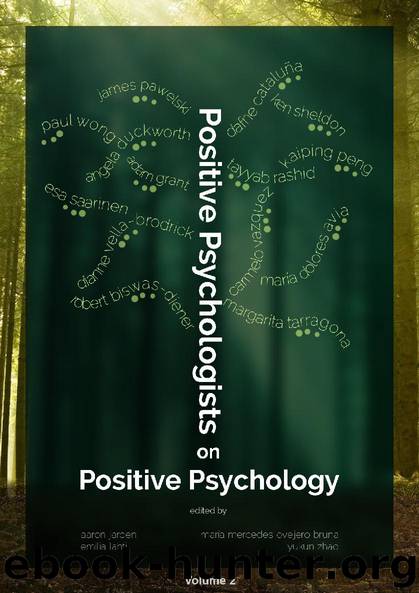
Author:Zhao, Yukun & Lahti, Emilia & Ovejero Bruna, María Mercedes & Jarden, Aaron
Language: eng
Format: epub
Publisher: Unknown
Published: 2013-12-29T00:00:00+00:00
Esa Saarinen
Esa Saarinen is professor of applied philosophy at Aalto University in Finland,
specializing in philosophy of life, creative problem solving and systems analysis. Dr. Saarinen is an eminent figure in his home country and a beloved international speaker, who has made it his life mission to tangibly improve the world, as well as to reduce emotional negativism by creating accessible contexts of personal insights on living one’s life. He is also a co-creator of a field called systems intelligence thinking. Dr. Saarinen has been a presenter for the current Master of Applied Positive Psychology class at the University of Pennsylvania.
In general terms and from your point of view, what are some of the defining features of positive psychology?
Positive psychology offers a scientific outlook to the classic Socratic call for a better life. Instead of approaching human beings from the perspective of deficiency, positive psychology investigates, identifies and helps foster “the better angels of our nature”, as Abraham Lincoln put it.
Could you tell us a bit about yourself? Who are you and what do you do? I’m a philosopher. I was trained in analytic philosophy, and was quite theoretically oriented at first, then went on to existentialism, philosophy of culture and to media philosophy, but for the past twenty years or so my interest has been in helping people live better in their everyday. I consider my approach as one of applied positive philosophy and as a positive philosophical practice. Much of my work takes place in lecture contexts, i.e. orally, rather than literally. I view philosophy as a performative art. The sources of inspiration are multiple but the aim is one: to create lecture-based contexts for people to engage in the reflection of their lives and their modes of thinking.
What prompted you to become interested in positive psychology? I came to positive psychology fairly late through my positive philosophical practice. That practice had started with my work with organizations in the 1990s and with my interest to develop the lecture form in an experiential and performative direction. In organizational settings, working with people of various ranks and professions, it was clear one could not ride with the argumentative, analytic and knowledge-based paradigms of academia. In particular, the need to make things work, and work better, was pressing. Even at the university, since the early 1980’s, I had searched for expressive power philosophy that would have emotional appeal and communicative reach. What helped that project was the fact that in 1980 I became a media figure, known as the “punk doctor”, as a result of some cultural interventions and controversial appearances. After meeting my special lady and falling in love with her, I continued the high profile approach I had already adopted and I just couldn’t help talking about her all the time, also at my lectures. Accompanied by constant media appearances all this created extra draw to the lectures. My passion was to find ways in which philosophy could be more relevant, more personal, more vitalistic and rock ‘n roll-like – a positive force in people’s lives and also great fun.
Download
This site does not store any files on its server. We only index and link to content provided by other sites. Please contact the content providers to delete copyright contents if any and email us, we'll remove relevant links or contents immediately.
Rewire Your Anxious Brain by Catherine M. Pittman(18810)
Talking to Strangers by Malcolm Gladwell(13560)
The Art of Thinking Clearly by Rolf Dobelli(10721)
Mindhunter: Inside the FBI's Elite Serial Crime Unit by John E. Douglas & Mark Olshaker(9532)
Becoming Supernatural by Dr. Joe Dispenza(8377)
Change Your Questions, Change Your Life by Marilee Adams(7938)
Nudge - Improving Decisions about Health, Wealth, and Happiness by Thaler Sunstein(7863)
The Road Less Traveled by M. Scott Peck(7737)
The Lost Art of Listening by Michael P. Nichols(7623)
Mastermind: How to Think Like Sherlock Holmes by Maria Konnikova(7556)
Enlightenment Now: The Case for Reason, Science, Humanism, and Progress by Steven Pinker(7442)
Win Bigly by Scott Adams(7350)
The Way of Zen by Alan W. Watts(6735)
Daring Greatly by Brene Brown(6634)
Big Magic: Creative Living Beyond Fear by Elizabeth Gilbert(5895)
Grit by Angela Duckworth(5747)
Ego Is the Enemy by Ryan Holiday(5639)
The Laws of Human Nature by Robert Greene(5452)
Men In Love by Nancy Friday(5388)
